Providing Storage savings and Comparable performance using VMware Cloud Flex Storage for Oracle Backups

You are as good as your last backupDBA 101 – the ability to allow restore & recovery from an earlier point in time to allow business recover from unplanned event.

We are all aware that slow database Backups will result in database backup’s spilling outside the production backup window resulting in disruption of database operations and breach of SLA’s as well.

Key points to take away from this blog

This blog is the second blog in the series of evaluating VMware Cloud Flex Storage as a viable & comparable Storage option for Oracle backups destination.

The first blog Providing Performance and Storage savings using VMware Cloud Flex Storage for Oracle Archivelogs  was an exercise to evaluate the feasibility and showcase the advantages of using VMware Cloud Flex Storage for business-critical Oracle workloads on VMware Cloud on AWS as a viable & comparable Storage option for Oracle Archivelog files destination.

Offloading Archivelog files and Backup dumps to VMware Cloud Flex Storage results in

  • Providing storage & comparable performance to Archivelog & Backup activities for the database
  • Ensuring Tier-1 vSAN Internal NVMe storage is reserved for hot/warm database data for capacity and performance.

This blog is not meant to be a performance benchmarking-oriented blog in any way. Remember, any performance data is a result of the combination of hardware configuration, software configuration, test methodology, test tool, and workload profile used in the testing, so the performance improvement I got with my workload in my lab is in no way representative of any real production workload which means the performance improvements for real world workloads will be better.

Continue reading


Posted in Oracle | Comments Off on Providing Storage savings and Comparable performance using VMware Cloud Flex Storage for Oracle Backups

Providing Performance and Storage savings using VMware Cloud Flex Storage for Oracle Archivelogs

Space: the final frontier – Oracle production workloads have stringent Storage & IO requirements with database Archivelog generation and database backup’s adding to performance and space demands with the ever-increasing database size.

Enabling, sustaining, and ensuring the highest possible performance along with continued application availability is a major goal for all mission critical Oracle applications to meet the demanding business SLA’s, all the way from on-premises to VMware Hybrid Clouds

  • Slow database Archivelog performance will considerably slow the database down resulting in breach of SLA’s.
  • Slow database Backups will result in database backup’s spilling outside the production backup window resulting in disruption of database operations and breach of SLA’s as well.

Key points to take away from this blog

This blog is an exercise to evaluate the feasibility and showcase the advantages of using VMware Cloud Flex Storage for business-critical Oracle workloads on VMware Cloud on AWS as a viable & comparable Storage option for

  • Oracle Archivelog files destination
  • Oracle Backup dump destination

Offloading Archivelog files and Backup dumps to VMware Cloud Flex Storage results in

  • Providing storage & comparable performance to Archivelog & Backup activities for the database
  • Ensuring Tier-1 vSAN Internal NVMe storage is reserved for hot/warm database data for capacity and performance.

This blog is not meant to be a performance benchmarking-oriented blog in any way. Remember, any performance data is a result of the combination of hardware configuration, software configuration, test methodology, test tool, and workload profile used in the testing, so the performance improvement I got with my workload in my lab is in no way representative of any real production workload which means the performance improvements for real world workloads will be better.

Continue reading
Posted in Oracle | Comments Off on Providing Performance and Storage savings using VMware Cloud Flex Storage for Oracle Archivelogs

Optimizing Oracle workload performance with VMware Guest Operating System Storage Improvements

Heads I win , Tail you gonna lose  – “Bon Jovi” !!!


Business Critical Oracle Workloads have stringent IO requirements and enabling, sustaining, and ensuring the highest possible performance along with continued application availability is a major goal for all mission critical Oracle applications to meet the demanding business SLA’s, all the way from on-premises to VMware Hybrid Clouds


When it comes to Business-Critical Oracle Workloads, the critical requirement is consistent performance and that does not involve tossing a coin every time someone runs a workload to determine whether that would meet the business SLA’s or not!!!


Key points to take away from this blog

This blog is a preview of the changes VMware Engineering will be working on to report more appropriate values for ‘Optimal transfer length’ and ‘Maximum transfer length’ fields in Vital Product Data (VPD) page B0 response, for the underlying physical device, hosting the vmdk’s, to Guest OS for optimal IO performance for Business-Critical Workloads on VMware platform.

This will ensure VMware vSphere platform is more performant for customers to run their Business-Critical workloads and to meet customers stringent SLA’s.

This blog is not meant to be a performance benchmarking-oriented blog in any way.

Remember, any performance data is a result of the combination of hardware configuration, software configuration, test methodology, test tool, and workload profile used in the testing, so the performance improvement I got with my workload in my lab is in no way representative of any real production workload which means the performance improvements for real world workloads will be better.

Continue reading
Posted in Oracle | Comments Off on Optimizing Oracle workload performance with VMware Guest Operating System Storage Improvements

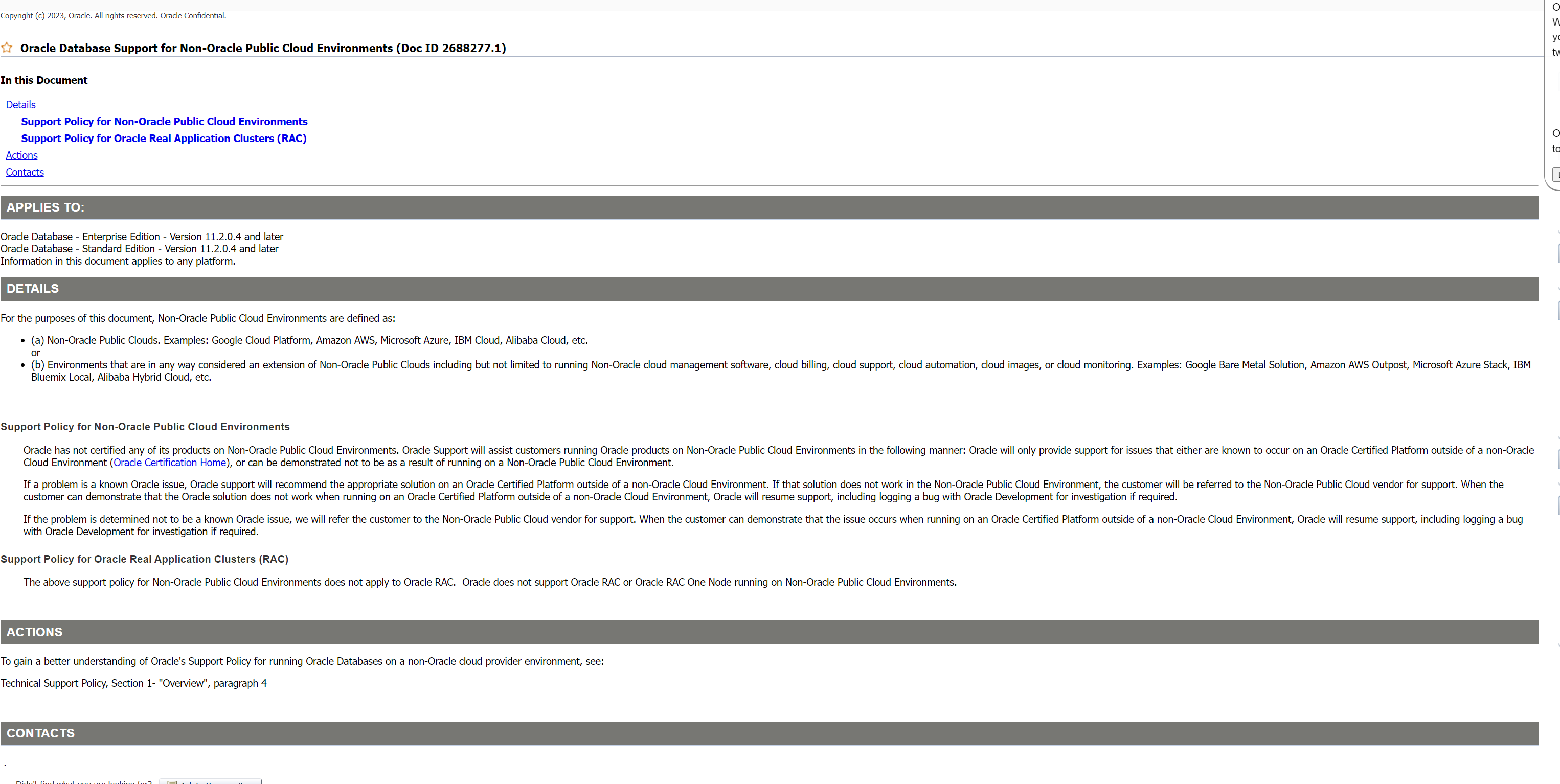
Oracle Database Support for Non-Oracle Public Cloud Environments – Doc ID 2688277.1 – Full text

The document My Oracle Support Note 2688277.1 “Oracle Database Support for Non-Oracle Public Cloud Environments (Doc ID 2688277.1)” has been copied from the Oracle MySupport site and re-produced below for benefit of those who do not have the Oracle MySupport credentials.

One would need Oracle My Support (old Metalink) credentials to see the Internal note.

This note is clearly a support-based Oracle MySupport note as per the verbiage below and is not related in any way to Oracle Licensing on VMware Hybrid Clouds.


Continue reading

Posted in Oracle | Comments Off on Oracle Database Support for Non-Oracle Public Cloud Environments – Doc ID 2688277.1 – Full text

Oracle Business Continuity and Disaster Recovery on VMware Hybrid Multi-Clouds – DR Use Cases

This blog is the second blog in the series of providing Business Continuity and Disaster Recovery to Oracle workloads on VMware Hybrid Multi-Clouds.

The first blogOracle Business Continuity and Disaster Recovery on VMware Hybrid Multi-Clouds” was released in 2021 and was the comprehensive reference architecture solution which described the configuration and implementation of various business continuity and disaster recovery options e.g. Native Oracle tools, VMware tools (SRM, vSphere Replication, Array based using VMFS/vVOLS, VSR , VCDR) across all 3 levels – Application, VMware platform, and Storage levels of both Oracle Single instance and Real Application Cluster (RAC) workloads on the VMware vSphere hybrid multi-cloud platform. This includes on-premises and VMware clouds, with an emphasis on VMware Cloud on AWS.

Key points to take away from this blog

This blog focusses primarily on use-case scenarios for providing Disaster Recovery for Oracle Single instance & Oracle RAC workloads, after being migrated / replatformed to VMware on-premises, with an aim of ultimately providing DR to VMware Hybrid Multi-Cloud from the below source platforms

  • Big-endian systems (Solaris, AIX, HP-UX)
  • Oracle Engineered Systems (e.g., Exadata, ODA etc)
  • Physical commodity x86-64 servers
  • non-VMware platform (OVM, LVM, KVM, Xen)

Continue reading
Posted in Oracle | Comments Off on Oracle Business Continuity and Disaster Recovery on VMware Hybrid Multi-Clouds – DR Use Cases

Deploying Oracle RAC on VMware vSphere 8.0 using NVMe/TCP with Lightbits Scale out Disaggregated Storage

This blog is the second blog in the series of “Deploying Oracle Workloads on VMware vSphere 8.0 using NVMe/TCP backed Lightbits software” blogs.

The first blog “Deploying Oracle Workloads on VMware vSphere 8.0 using NVMe/TCP with Lightbits Scale out Disaggregated Storage” can be found here.

Business Critical Oracle Workloads have stringent IO requirements and enabling, sustaining, and ensuring the highest possible performance along with continued application availability is a major goal for all mission critical Oracle applications to meet the demanding business SLA’s, all the way from on-premises to VMware Hybrid Clouds.

Oracle RAC provides high availability and scalability by having multiple instances access a single database which prevents the server from being a single point of failure. Oracle RAC enables you to combine smaller commodity servers into a cluster to create scalable environments that support mission critical business applications.

With increasing need for data to be “fast and furious”, customers are turning to NVMe transfer protocol for accessing data quickly from flash memory storage devices such as solid-state drives (SSDs).

NVMe, or nonvolatile memory express, is a storage access protocol and transport protocol for flash and next-generation solid-state drives (SSDs) that delivers high throughput and fast response times for a variety of traditional and modern workloads. While all-NVMe server-based storage has been available for years, the use of non-NVMe protocols for storage networking can add significant latency.

To address this performance bottleneck, NVMe over TCP or NVMe/TCP, extends NVMe’s performance and latency benefits across TCP based network fabric.

We’ve heard from our customers that they would like to run NVMe/TCP because:

  • TCP/IP is ubiquitous
  • Well understood – TCP is probably the most common transport
  • High performance – TCP delivers excellent performance scalability
  • Well suited for large scale deployments and longer distances
  • Actively developed – maintenance and enhancements are developed by major players
  • Inherently supports in-transit encryption

More information on NVMe/TCP Support with VMware vSphere 7 Update 3 can be found here.

More information on VMware NVMe Concepts can be found here.

Key points to take away from this blog

This blog is not meant to be a performance benchmarking-oriented blog.

This blog is meant to raise the awareness of the simplicity and seamless use of NVMe/TCP storage backed datastores provided by Lightbits Storage to provide vmdk based storage for business-critical Oracle RAC workloads.

Continue reading

Posted in Oracle | Comments Off on Deploying Oracle RAC on VMware vSphere 8.0 using NVMe/TCP with Lightbits Scale out Disaggregated Storage

Deploying Oracle Workloads on VMware vSphere 8.0 using NVMe/TCP with Lightbits Scale out Disaggregated Storage


Business Critical Oracle Workloads have stringent IO requirements and enabling, sustaining, and ensuring the highest possible performance along with continued application availability is a major goal for all mission critical Oracle applications to meet the demanding business SLA’s, all the way from on-premises to VMware Hybrid Clouds

With increasing need for data to be “fast and furious”, customers are turning to NVMe transfer protocol for accessing data quickly from flash memory storage devices such as solid-state drives (SSDs).

NVMe, or nonvolatile memory express, is a storage access protocol and transport protocol for flash and next-generation solid-state drives (SSDs) that delivers high throughput and fast response times for a variety of traditional and modern workloads. While all-NVMe server-based storage has been available for years, the use of non-NVMe protocols for storage networking can add significant latency.

To address this performance bottleneck, NVMe over TCP or NVMe/TCP, extends NVMe’s performance and latency benefits across TCP based network fabric.


We’ve heard from our customers that they would like to run NVMe/TCP because:

  • TCP/IP is ubiquitous
  • Well understood – TCP is probably the most common transport
  • High performance – TCP delivers excellent performance scalability
  • Well suited for large scale deployments and longer distances
  • Actively developed – maintenance and enhancements are developed by major players
  • Inherently supports in-transit encryption

More information on NVMe/TCP Support with VMware vSphere 7 Update 3 can be found here.

More information on VMware NVMe Concepts can be found here.


Key points to take away from this blog


This blog is not meant to be a performance benchmarking-oriented blog.

This blog is meant to raise the awareness of the simplicity and seamless use of NVMe/TCP storage backed datastores provided by Lightbits Storage to provide vmdk based storage for Oracle workloads.

Oracle workloads can take advantage of NVMe/TCP storage using VM vNVME controller backed vmdk’s on those NVMe/TCP storage enhancing performance with high throughput, low latency, fast response times and reduced CPU utilization.

From an Oracle workload or pretty much any Application on VMware platform, from a functional perspective, a vmdk carved form a NVMe/TCP backed Datastore is just a regular vmdk which then gets attached to the VM and gets consumed the same way as any regular vmdk on a VMFS /vVOL / NFS / vSAN datastore.


Continue reading

Posted in Oracle | Comments Off on Deploying Oracle Workloads on VMware vSphere 8.0 using NVMe/TCP with Lightbits Scale out Disaggregated Storage

vMotion of Oracle RAC on VMware with Change Block Tracking (CBT)


Business Critical Oracle Workloads have stringent IO requirements and enabling, sustaining, and ensuring the highest possible performance along with continued application availability is a major goal for all mission critical Oracle applications to meet the demanding business SLA’s, all the way from on-premises to VMware Hybrid Clouds

Oracle RAC provides high availability and scalability by having multiple instances access a single database which prevents the server from being a single point of failure. Oracle RAC enables you to combine smaller commodity servers into a cluster to create scalable environments that support mission critical business applications.


Key points to take away from this blog


This blog showcases the validation of vMotion capability for Oracle RAC cluster on VMware vSphere Platform which can be achieved seamlessly without any issue, with appropriate settings in place

  • with Change Block Tracking (CBT) enabled for non-shared disk
  • with multi-writer attribute set for the shared vmdk’s


Continue reading

Posted in Oracle | Comments Off on vMotion of Oracle RAC on VMware with Change Block Tracking (CBT)

Oracle workloads on VMware Virtual Volumes (vVOLS) using Pure Storage FlashArray X50 and Broadcom LPe36000 Fibre Channel Adapter – better performance


“He-Man and the Masters of the Universe” – I have the power!!!! Yes, you do……with VMware Virtual Volumes (vVols) using Pure Storage FlashArray X50 and Broadcom LPe36000 Fibre Channel Adapter.


Business Critical Oracle Workloads have stringent IO requirements and enabling, sustaining, and ensuring the highest possible performance along with continued application availability is a major goal for all mission critical Oracle applications to meet the demanding business SLA’s, all the way from on-premises to VMware Hybrid Clouds

This blog is only meant to showcase the performance improvements we got in our lab by deploying Oracle workloads on VMware Virtual Volumes (vVols) datastore [SCSI-vVols] on ESXi 7.0.3 using Pure Storage FlashArray X50 and Broadcom LPe36000 Fibre Channel Adapter and is by NO means a performance benchmark blog.

This blog contains results that I got in my lab running a load generator SLOB against my workload, which will be way different than any real-world customer workload, your mileage may vary.

Remember, any performance data is a result of the combination of hardware configuration, software configuration, test methodology, test tool, and workload profile used in the testing.


Continue reading

Posted in Oracle | Comments Off on Oracle workloads on VMware Virtual Volumes (vVOLS) using Pure Storage FlashArray X50 and Broadcom LPe36000 Fibre Channel Adapter – better performance

Deploying Oracle RAC on VMware vSphere using NVMe-oF/FC with Pure X50 FlashArray and Broadcom LPe36000 Fibre Channel Adapter

Business Critical Oracle Workloads have stringent IO requirements and enabling, sustaining, and ensuring the highest possible performance along with continued application availability is a major goal for all mission critical Oracle applications to meet the demanding business SLA’s, all the way from on-premises to VMware Hybrid Clouds

Oracle RAC provides high availability and scalability by having multiple instances access a single database which prevents the server from being a single point of failure. Oracle RAC enables you to combine smaller commodity servers into a cluster to create scalable environments that support mission critical business applications.

With increasing need for data to be “fast and furious”, customers are turning to NVMe transfer protocol for accessing data quickly from flash memory storage devices such as solid-state drives (SSDs).

NVMe over Fibre Channel (NVMe/FC) is a technology specification designed to enable NVMe-based message commands to transfer data and status information between a host computer and a target storage subsystem over a Fibre Channel network fabric, providing sustained, predictable performance and catering to low latency requirements of mission critical workloads.

KB 1034165 currently has the guidance “When using the multi-writer mode, the virtual disks must NOT be attached to the virtual NVMe controller.”.

This blog is a pre-validation of the deployment and configuration of Oracle RAC on VMware vSphere using NVMe/FC protocol with Pure X50 FlashArray and Broadcom LPe36000 Fibre Channel Adapter, pending official VMware Engineering validation efforts , currently in progress , into using vNVMe controllers for shared vmdk’s with multi-writer attribute using NVMe-oF/FC protocol.

The official guidance is that Customers deploy their Oracle RAC using vNVMe controllers for shared vmdk’s with multi-writer attribute using NVMe-oF/FC protocol , ONLY after KB 1034165 is updated.

Continue reading
Posted in Oracle | Comments Off on Deploying Oracle RAC on VMware vSphere using NVMe-oF/FC with Pure X50 FlashArray and Broadcom LPe36000 Fibre Channel Adapter