Storage vMotion for Oracle Non-RAC Workloads within same vSphere Cluster

In the world of Business-Critical Applications, especially IO intensive Oracle workloads, there is always a need for storage migration, based on the ever-demanding workload profile. For example,

  • Migrate storage from one Tier to another Tier within a storage array
  • Migrate storage from one array to another array (within a datacenter and even between datacenters as part of DC relocation)

This approach is independent of whether those workloads are virtualized or not. The end goal is to ensure that the underlying storage architecture can provide and sustain the demanding needs of the Application.

This article describes how storage migration can be performed for Oracle database running on VMware vSphere, for any types of underlying storage.  The migration is done using a combination of two key technologies depending on the database deployment model

  • VMware Storage vMotion
  • Oracle Automatic Storage Management (ASM).

Before describing this technique, we first review some key ideas, including the deployment model of Oracle on vSphere and the fundamentals of Storage vMotion.

This blog focuses on Storage vMotion of Oracle Non-RAC workloads within the same vSphere Cluster.

Continue reading


Posted in Oracle | Comments Off on Storage vMotion for Oracle Non-RAC Workloads within same vSphere Cluster

Hot Remove CPU and Memory for Oracle production workloads

The previous blog On Demand Scaling up resources for Oracle production workloads – Hot Add CPU and Hot Add Memory focused on how to stop hoarding much needed infrastructure resources and live wisely ever after by scaling up as needed effectively.

This blog focuses on the Hot Remove CPU and Memory aspect of Oracle Workloads and the current limitations associated with these technologies.

Continue reading
Posted in Oracle | Comments Off on Hot Remove CPU and Memory for Oracle production workloads

VMworld 2021 – Breakout Sessions, Expert Round Tables and Demos focused on Business Critical Applications (BCA)

Join us at VMworld 2021 to learn how Business Critical Apps benefit from our latest platforms  

VMworld 2021 will be a global online event starting October 5-7, 2021, While the program will be adapted to fit the new digital format, VMworld will still be the place to learn about innovative new technology solutions, hear perspectives from VMware executives, dive into educational and technical content, and engage with experts across the industry ecosystem.

At VMworld 2021 you can immerse yourself in learning about Workload/Business Critical Applications (BCA) with a rich line up of Breakout Sessions, Expert Round tables and Demos.  Discover how fast and efficient it is to expand to a hybrid cloud to offer flexibility across many workloads diverse as Oracle, Microsoft SQL Server, Active Directory, Machine Learning and Artificial Intelligence featured in the session lineup.

Checkout the must-see sessions, expert round tables and demos below for Workloads/BCA:

#############
Breakout Sessions
#############

Oracle

  • MCL1089 Streamlining Oracle Workloads from On Premises to the VMware Hybrid Multi-Clouds

Microsoft

  • 1318 – Virtualizing Microsoft SQL Server on vSphere – Stories from the Trenches
  • 1198 – Virtualizing Active Directory – Doing it Right!

###############
Expert Round tables
###############

Oracle

  • MCL1144 Architecting Oracle Workloads on VMware Hybrid Cloud with Best Practices

##########
vBrownbag
##########

Oracle

  • Streamlining Oracle Workloads from on-premises to the VMware Hybrid Cloud
  • Accelerating Oracle workloads on VMware Hybrid Clouds

######
Demos
######

Posted in Oracle | Comments Off on VMworld 2021 – Breakout Sessions, Expert Round Tables and Demos focused on Business Critical Applications (BCA)

Deploying Oracle Workloads on vSAN HCI Mesh Compute Cluster – Disaggregating Compute and Storage

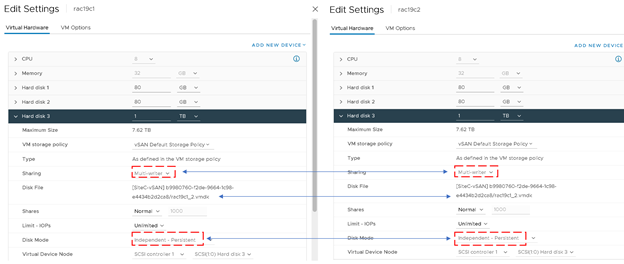
The previous blog No downtime Storage vMotion of Oracle RAC Cluster using shared vmdk’s with multi-writer attribute from one vSAN to another vSAN Cluster using VMware HCI Mesh demonstrated how we can achieve Storage vMotion of Oracle RAC Cluster using shared vmdk’s with multi-writer attribute ONLINE , with NO downtime, from one vSAN to another vSAN Cluster using VMware HCI Mesh.

The previous blog also touched on briefly a very important use case for Oracle workloads on any architecture, Oracle Licensing.

With vSAN HCI Mesh introduced in vSAN 7 Update 1 capability, one could seamlessly and transparently

  • move Oracle compute into smaller density (Physical sockets / cores) servers in a different vSAN cluster, thereby significantly reducing their Oracle Licensing costs
  • move the Storage for Oracle workloads into a different vSAN cluster, if needed, where excess storage capacity is available

With vSAN 7 Update 2, VMware introduces a significant new capability to vSAN HCI Mesh where traditional vSphere clusters can now mount a remote vSAN datastore.

Yes, we have a winner

This blog demonstrates how we can provision separate Compute and Storage resources for Oracle workloads on vSAN 7 Update 2 Cluster, disaggregating Compute and Storage, with Compute on traditional vSphere Clusters / vSAN Clusters and Storage on vSAN Storage , with a focus on reducing Oracle licensing using HCI Mesh Compute Clusters.

Continue reading
Posted in Oracle | Comments Off on Deploying Oracle Workloads on vSAN HCI Mesh Compute Cluster – Disaggregating Compute and Storage

On Demand hot extend clustered vmdk’s online without downtime – Hot Extend RAC clustered disks using Oracle ASM Rebalance and vSphere


This blog focuses on the complete list of steps to be taken to increase the size of the clustered vmdk(s) using Multi-writer flag of an Oracle RAC Cluster. 

This blog describes the various options using both Native Oracle tools and vSphere tools to attempt to increase the size of the Oracle RAC clustered vmdk(s).

Current restriction of shared vmdk’s using the multi-writer attribute is that Hot extend virtual disk is disallowed as per KB 1034165 & KB 2121181


Continue reading

Posted in Oracle, VMware Hybrid Cloud | Comments Off on On Demand hot extend clustered vmdk’s online without downtime – Hot Extend RAC clustered disks using Oracle ASM Rebalance and vSphere

Reclaiming dead space from Oracle databases on VMware Hybrid Platform


Dead space reclamation has always been a challenge especially with thin-provisioned volumes. Thin provisioning dynamically allocated storage on-demand to the workloads in a flexible and efficient manner.

Any database day to day 2 operations would include dropping tablespaces, dropping or resizing datafiles, truncating tables, deleting archive logs from ASM FRA diskgroup etc. .

One would expect the free space to go back to the storage free pool to be used for further allocation purposes, but that ability depends on

  • How the Application reports the discarded space to the GOS (Guest Operating System)
  • How the GOS reports the discarded space to underlying VMware layer
  • And eventually how VMware vSphere reports the discarded space to the Storage array


This blog focuses on the Oracle ASM Filter Driver (ASMFD) capability to report discarded or free space of thin-provisioned vmdk’s to the GOS which eventually gets reported to the VMware datastores and the underlying Storage array.


Continue reading

Posted in Oracle, VMware Hybrid Cloud | Comments Off on Reclaiming dead space from Oracle databases on VMware Hybrid Platform

Oracle Java on VMware Hybrid Cloud Platform – Dispelling the Oracle Java Licensing myths

This is just another blog (JAB) about Dispelling the “Galaxy Licensing” Oracle Java on VMware FUD  perpetuated by overzealous licensing and sales teams, which is in complete contrast to the reality of the actual Contractually Impactful documents.

 This blog intends to clear up the reality of how to effectively license Oracle Java workloads on VMware Hybrid Cloud ( vSphere, vSAN , VxRAIL , VMware Cloud on AWS and other VMware Cloud Platforms) and to make it a cost effective one as well.


Java Licensing Model – 2023


January 23rd 2023, Oracle made significant changes to how they license Java.

There are three main points in Oracle’s announcement:

First, Oracle no longer offers subscription Java on a Processor or Named User Plus model.

Second, going forward, the only model available is an employee-based license. If you want to license Java from Oracle you have to license all of your full time, part time, temporary employees, and contractors. This is the policy regardless of whether they are actually using the software.

Finally, Oracle announced that existing Java subscription clients can renew their Java contracts under the same “terms” and “metrics.”


The nuances of the what’s changed, what does it mean and what do I do is well articulated in Oracle Java Licensing Changes – January 2023 and  The New Oracle Java Pricing: What You Need to Know

Please review the above blogs for the steps you can take to protect yourself NOW and get the most from Java.


Java Licensing Models – 2019 and earlier


Starting this section onwards – all of the information below is relevant ONLY for Java Licensing Models 2019 and earlier and the steps to be compliant with the Java licensing rules are also relevant for Java Licensing Models 2019 and earlier.

Prior to 2019, there were three Java SE products known as

  • Java SE Advanced
  • Java SE Advanced Desktop
  • Java SE Suite


These models required commercial users to purchase upfront licenses and pay annual support.


Starting 2019, the above three models was replaced by two new subscription-based models

  • Java SE Subscription
  • Java SE Desktop Subscription


As per this model, one no longer needs to purchase licenses upfront and pay annual support for Java SE.  Instead, one would have to pay a monthly subscription fee under one to three-year terms for server or desktop licensing and support.


Continue reading

Posted in Java, VMware Hybrid Cloud | Comments Off on Oracle Java on VMware Hybrid Cloud Platform – Dispelling the Oracle Java Licensing myths

No downtime Storage vMotion of Oracle RAC Cluster using shared vmdk’s with multi-writer attribute from one vSAN to another vSAN Cluster using VMware HCI Mesh

The previous blog post “Around the “Storage World” in no time – Storage vMotion for Oracle Workloads (RAC & Non-RAC) within same vSphere Cluster” addressed the following use cases of Storage vMotion of an Oracle RAC Cluster with shared vmdk(s) using multi-writer attribute .


The following uses cases were addressed by the previous blog post for Oracle RAC clusters within the same vSphere Cluster –

  • Migrate Oracle database storage from one Tier to another Tier within a storage array
  • Migrate Oracle database storage from one array to another array (within and between data centers) for the same datastore type [ VMFS . NFS, iSCSI, vVOL, vSAN]
  • Migrate Oracle database storage from one array to another array (within and between data centers) across different datastore types [ VMFS , NFS, iSCSI, vVOL, vSAN]


Continue reading

Posted in Oracle, VMware Hybrid Cloud | Comments Off on No downtime Storage vMotion of Oracle RAC Cluster using shared vmdk’s with multi-writer attribute from one vSAN to another vSAN Cluster using VMware HCI Mesh

Backing up Oracle Workloads (RAC & Non-RAC) with VMware Snapshot Technology


In computer systems, a snapshot is the state of a system at a particular point in time. To avoid downtime, high-availability systems may instead perform the backup on a snapshot—a read-only copy of the data set frozen at a point in time—and allow applications to continue writing to their data. [ Wikipedia ]

This blog addresses how one can take VM level snapshot of Oracle Single Instance / RAC workloads using VMware snapshot technology, keep certain caveats in mind.


Continue reading

Posted in Oracle, VMware Hybrid Cloud | Comments Off on Backing up Oracle Workloads (RAC & Non-RAC) with VMware Snapshot Technology

Oracle Real Application Cluster (RAC) Support on VMware Clouds

Oracle Real Application Cluster (RAC) Support on VMware Clouds


As of December 9th, 2020, VMware recommends that anyone currently running OR planning to run, an Oracle Real Application Cluster (RAC) in a VMware Cloud environment, reach out to Oracle Corporation for any Oracle support related matters with RAC on our cloud platform.


Please reach out to your VMware representative for any clarifications on the below guidance’s.


Continue reading

Posted in Oracle, VMware Hybrid Cloud | Comments Off on Oracle Real Application Cluster (RAC) Support on VMware Clouds